Real K-pop Slang Dictionary: Fandom Words Explained
At a glance
- In shortExplains common Korean K-pop slang terms, fandom culture, where to shop, and usage mistakes.
- Best forInternational K-pop fans navigating fandom language
- WhereSeoul
- Key pointsTerms like Choe-ae, Cha-ae, and Ipdok explain fan identity and status. · Pho-ka, Top-ku, and Pyoketting cover photocard collecting and ticketing. · Use official platforms like Weverse Shop and Ktown4u for chart reporting.
- Heads-upAvoid overusing Oppa or Unnie; modern fans often use full names with -nim or updated slang.
Last month, I was sitting at a small coffee shop in Hongdae when I overheard two visiting foreign K-pop fans arguing over their Twitter feeds. One was trying to explain why her "Choe-ae" changed after seeing a live stage in Seoul, while her friend kept confusing the word "Ipdok" with "Tal-dok." As a Korean who has watched fandom culture evolve over the past fifteen years, I realized just how complex our domestic fandom language must seem to international fans. What starts as simple Korean vocabulary quickly morphs into condensed internet acronyms, clever cultural puns, and slang that even native Koreans outside the idol community sometimes struggle to decode.
If you want to understand what Korean fans are tweeting, write letters to your favorite idols on fan platforms, or navigate photocard trading in Seoul without getting lost, having a proper kpop slang dictionary is essential. Here is a practical, local breakdown of the most common terms used inside Korean fandoms today, along with practical advice on how to use them correctly.
1. The Identity Terms: Who You Stan and How You Joined
In the Korean fandom world, standard dictionary Korean rarely applies. Fandom language relies heavily on Sino-Korean roots mixed with abbreviated Korean compound words. Understanding these foundational terms will help you explain exactly where you stand in any group’s fandom.
Choe-ae (최애) and Cha-ae (차애)
Your Choe-ae (최애) is your ultimate bias—the idol you love most in a group or across the entire industry. The term comes from combining the Hanja character Choe (최 / 最, meaning "most" or "best") and Ae (애 / 愛, meaning "love"). Your Cha-ae (차애) uses the character Cha (차 / 次, meaning "second"), making it your bias wrecker or second favorite member.
As a Korean fan, you will often hear people ask, "Who is your Choe-ae?" when meeting other fans at concert venues or cupsleeve events. If you love everyone equally, you can call yourself an All-paen (올팬), meaning an "all-fan" or OT (One True) group supporter.
Ipdok (입덕) and Tal-dok (탈덕)
The syllable Deok (덕) comes from Deok-hu (덕후), which is the Korean adaptation of the Japanese word Otaku (meaning a dedicated obsessive enthusiast). When you add prefixes to Deok, you create an entire vocabulary for fandom behavior:
- Ipdok (입덕): "Ip" means to enter. Ipdok refers to the exact moment or process of entering a fandom. For example, "I watched their dance practice video and executed an immediate Ipdok."
- Tal-dok (탈덕): "Tal" means to escape or leave. This refers to leaving a fandom or unstanning a group.
- Deok-tong-sago (덕통사고): A combination of Deok and Gyo-tong-sa-go (traffic accident). It describes falling into a fandom suddenly and unexpectedly, like getting hit by a car out of nowhere.
- Deok-saeng (덕생): Short for "fandom life." Korean fans often say "Happy Deok-saeng!" to wish each other an enjoyable time supporting their idols.
Seong-deok (성덕) and Il-ko (일코)
A Seong-deok (성덕) is a "successful fan" (성공한 덕후). This term is used when a fan manages to get noticed by their idol, wins a video call fansign, or works in an industry where they end up collaborating with their favorite celebrity.
On the flip side, Il-ko (일코) is short for Il-sang Cosplay (일상 코스프레), which means pretending to be a "normal non-fan" in everyday life. If you hide your idol phone wallpaper at your office job in Seoul, you are actively practicing Il-ko.
✈️ Book your trip to Korea — hotels, flights & more
2. Concerts, Merch, and Album Slang
Navigating K-pop events in Korea requires an entirely separate set of terms. Whether you are attempting to buy tickets online or trading photocard pulls at a pop-up store, these terms appear constantly.
Pho-ka (포카) and Top-ku (탑꾸)
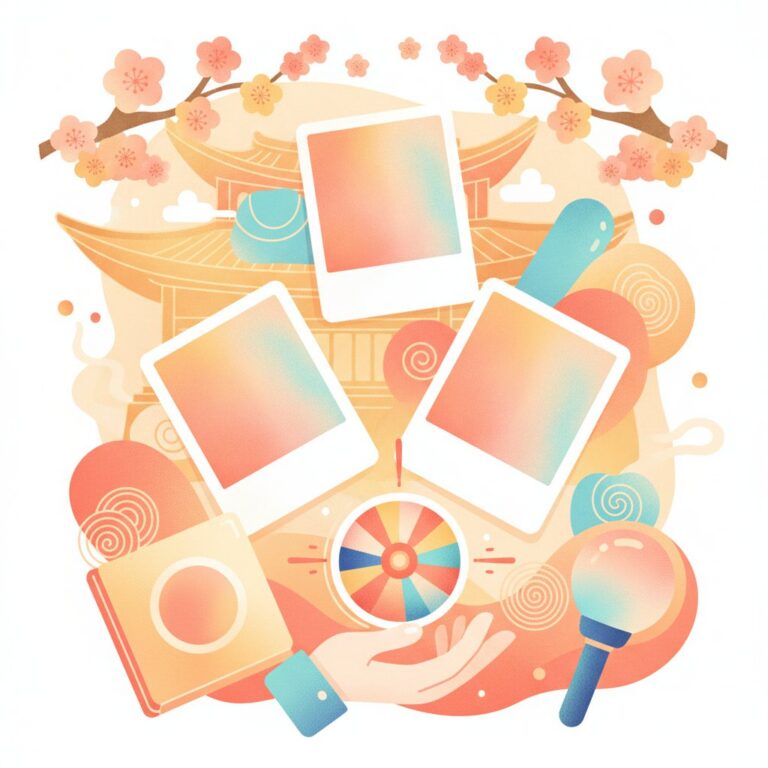
Photocards are the center of the K-pop collecting universe. In Korea, nobody says "photocard" in full; everyone says Pho-ka (포카). Decorating the plastic protective loaders used for these cards is known as Top-ku (탑꾸), short for Top-loader Kkumi-gi (top-loader decorating).
If you visit stationary shops in busy Seoul districts like Myeongdong or Hongdae, you will find entire aisles dedicated to Top-ku stickers, hard sleeves, and binder pages. Basic photocard protective sleeves typically cost between 2,000 and 5,000 KRW (roughly $1.50 to $4.00 USD) per pack, making it an accessible hobby for collectors.
Pyo-ket-ting (표켓팅)
Ticketing for concerts in Korea is notoriously competitive. Fandoms combine the word Pyo (표, ticket) with Ticketing to form Pyo-ket-ting (표켓팅). When a venue sells out in under thirty seconds, Korean fans describe the process as blood-curdling or impossible.
If you fail to get a ticket during initial sales, you might look for a 취켓팅 (Chwi-ket-ting), which refers to grabbing canceled tickets when ticketing sites process unpaid orders (usually around midnight or 2:00 AM Korean Standard Time).
Quick Reference Guide: Common K-pop Slang
| Term | Hangul | Meaning |
|---|---|---|
| Choe-ae | 최애 | Ultimate Bias / Favorite Member |
| Ipdok | 입덕 | Becoming a fan / Entering fandom |
| Pho-ka | 포카 | Photocard |
| Top-ku | 탑꾸 | Decorating photocard top-loaders |
| Pyoketting | 표켓팅 | Competitive concert ticketing |
| Deok-mae | 덕매 | Fandom friend / Stan buddy |
🎟️ Popular tours & experiences in Korea
Klook.com3. Where to Use Fandom Terms and Buy Official Goods
Knowing the terms is only half the battle; knowing where Korean fans hang out and shop is where your fan experience truly improves. Korean fans mostly communicate on specialized platforms and shop through verified distributors.
Where Fandom Conversations Happen
- Weverse: The primary official community platform for dozens of major groups. Idols regularly post translated messages, and fans leave comments using Korean slang.
- DearU Bubble: A subscription messaging service where idols send chat-style messages directly to subscribers. Fans use concise Korean phrases in their limited reply character counts.
- X (Twitter): The hub for photocard trading, venue meetups, and real-time concert updates in Korea. Searching hashtags like #Pho-ka_Yang-do (#포카_양도, photocard transfer/sale) is the standard way to find missing album pulls.
Buying Official Merch Safely
When purchasing official items, it is best to stick to established, official retailers to guarantee chart reporting (Hanteo and Circle Chart) and avoid bootlegs. Here are the most trustworthy platforms for international and local fans:
- Weverse Shop: The official platform for lightsticks, official tour merch, and album pre-orders. Official lightsticks generally range from 45,000 to 60,000 KRW ($35–$45 USD), depending on features like Bluetooth sync.
- Ktown4u: Excellent for international shipping with fan-club discount links. Standard K-pop albums usually run between 20,000 and 35,000 KRW ($15–$27 USD) depending on the edition.
- YesAsia: A long-standing global distributor for Korean music, DVDs, and photobooks with global fulfillment options.
- Olive Young Global: While primarily a K-beauty hub, they frequently carry idol-endorsed cosmetic collections, collab merch, and photocard promotional sets.
4. Nuances and Common Mistakes to Avoid
As a native speaker, I often see international fans misuse certain Korean honorifics or terms when trying to integrate slang into English sentences. Here are two common mistakes to watch out for:
First, avoid overusing honorifics like Oppa (오빠) or Unnie (언니) in public fandom spaces unless you are writing directly to the idol in a friendly context. In formal Korean fan communities, fans usually address members by their full name followed by the suffix -nim (님), such as "Soobin-nim" or "Chaewon-nim," to maintain a respectful distance.
Second, remember that slang changes quickly. Words like Dae-bak (대박, amazing) or Eol-jjang (얼짱, handsome face) were popular a decade ago, but modern K-pop fans prefer terms like 비주얼 갑 (Visual Gap) or Eol-gul-chen-jae (얼굴천재, face genius) to praise an idol’s visuals. Keeping your vocabulary updated ensures your messages sound natural when chatting with domestic fan buddies (Deok-mae).
FAQ
What does ‘ipdok’ mean in K-pop?
‘Ipdok’ (입덕) means the moment or process of becoming a fan of a K-pop group or celebrity. It combines ‘Ip’ (enter) and ‘Deok’ (fandom/otaku culture).
How do K-pop fans buy official merch and photocards in Korea?
Official merchandise is usually bought online through official platforms like Weverse Shop and Ktown4u, or at physical pop-up stores in Seoul. Photocards are frequently traded or resold between fans on X (Twitter) using tags like #포카_양도.
What is the difference between choe-ae and cha-ae?
‘Choe-ae’ (최애) refers to your absolute favorite member or ultimate bias in a group. ‘Cha-ae’ (차애) refers to your second-favorite member or bias wrecker.
More on K-Pop Industry & Fandom
- How Korea's K-Pop Trainee System WorksAn overview of how K-pop trainees are recruited, trained, evaluated, and debuted in Seoul.
- Korean Music Streaming Apps GuideExplains how Korean music charts work and how global fans can stream on domestic platforms.
- Weverse K-pop Fan Club Memberships ExplainedA step-by-step guide to K-pop Weverse fanclub memberships, perks, and purchases.
See every K-Pop Industry & Fandom post in our K-POP guide.
Handy toolsKorea travel essentials · Korea Guide Finder
🎟️ Popular tours & experiences in Korea
Klook.comKeep Reading
- How to Book a K-Pop Idol Makeup Salon in Seoul
- How to Visit K-pop Pop Up Stores in Seoul
- Idol Owned Cafes in Seoul Every K-Pop Fan Should Visit
- How to Find K-Pop Subway Ads in Seoul
🎟️ Popular tours & experiences in Korea
Klook.com