Practical Korean Dining Etiquette Tips for Your First Trip
At a glance
- In shortCovers basic mechanics, table etiquette, drinking customs, and payment rules in Korea.
- Best forFirst-time foreign visitors and travelers in South Korea
- WhereNationwide
- Key pointsKeep rice and soup bowls on the table rather than lifting them. · Utensils are often stored in table drawers, and water is often self-service. · Use two hands when giving or receiving drinks, and do not leave tips.
- Heads-upNever stick chopsticks upright into rice, as it resembles funeral rituals.
The Unspoken Flow of Korean Dining
The first time I took an international friend out for pork belly in Seoul, he picked up his stainless steel rice bowl and held it right under his chin to eat. In many Asian countries, lifting your bowl is polite and practical. In Korea, however, keeping your bowl firmly on the table is standard etiquette. Seeing his confusion when I gently pointed this out reminded me how many subtle, unwritten rules exist inside a Korean restaurant.
As a Korean, I often notice foreign visitors feeling slightly overwhelmed during their first few meals here. Between tables equipped with hidden drawers, self-service water stations, communal stew pots, and the absence of traditional tipping, dining out in Korea is interactive, fast-paced, and deeply social. Once you understand the basic mechanics of how a Korean meal works, you will feel completely at home in everything from a bustling neighborhood gimbap shop to a high-end Korean barbecue joint.
✈️ Book your trip to Korea — hotels, flights & more
Entering, Seating, and Getting Your Server’s Attention
When you walk into a traditional or casual Korean restaurant, you might notice people seated on raised wooden platforms requiring you to remove your shoes, though modern chairs and tables are far more common today. If you do encounter a floor-seating establishment, look for shoe racks near the entrance. Always slip off your shoes before stepping onto the raised floor area.
Finding Your Utensils and Napkins
After sitting down, do not be alarmed if you do not see forks, knives, spoons, or napkins on top of the table. In most casual and mid-range Korean eateries, utensils are stored in a pull-out drawer attached to the side or front of your table. Slide it open, and you will find stainless steel chopsticks, long-handled spoons, and paper napkins. If there is no drawer, look for a small container placed at the edge of the table or on a nearby shelf.
How to Call the Server Efficiently
In many Western countries, making eye contact or waiting patiently for a server to check on you is standard practice. In Korea, efficiency is key, and waiting silently might leave you empty-handed for a long time. Check your table surface for a small plastic call button, usually labeled with the word Bell or a small bell icon. Pressing this button rings a chime in the kitchen and alerts the staff that you are ready to order, need a side dish refill, or want the bill.
If there is no call button on your table, do not hesitate to speak up. Call out firmly and politely using the phrase Jeogiyo (pronounced juh-gi-yo), which roughly translates to “Excuse me over here.” You can also say Sajangnim (pronounced sah-jang-neem), which means “Boss” or “Owner.” Servers expect this call and will appreciate your directness rather than considering it rude.
Navigating Water and Self-Service Stations
Water in Korean restaurants is almost always free, but it is frequently self-service. If a server does not bring a cold water bottle to your table right away, look around the dining room for a water dispenser or a small refrigerator stocked with metal cups and water bottles. You will often see a sign reading Mul-un Self (Water is self-service). Feel free to stand up and grab a bottle or fill your cup directly from the dispenser.
Chopsticks, Bowls, and Handling Your Cutlery
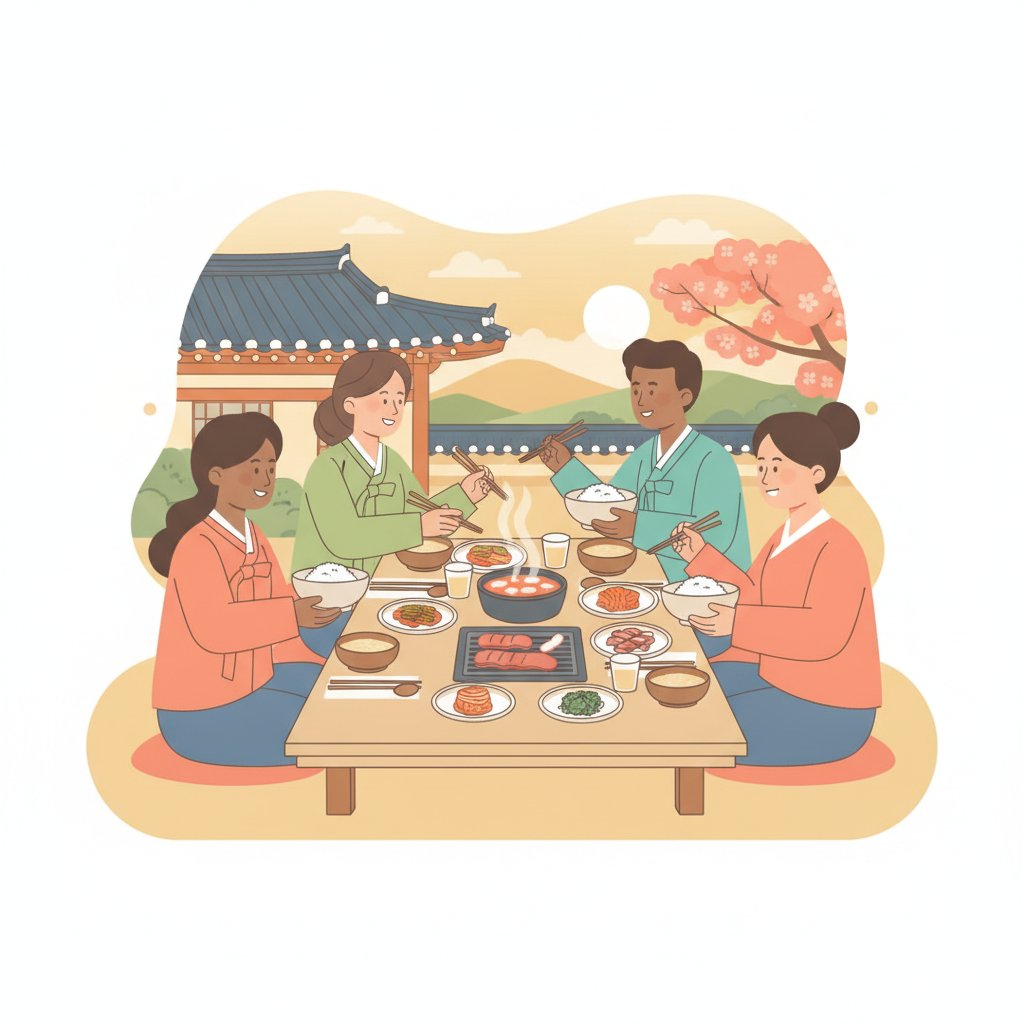
Korean table settings rely on a pair of flat, stainless steel chopsticks and a long-handled stainless steel spoon, collectively referred to as sujeo. Handling these items correctly is one of the most visible ways to show respect for local dining culture.
Keep Bowls on the Table
Unlike dining in Japan or China, where lifting rice and soup bowls closer to your mouth is standard, Korean custom dictates that all bowls stay on the table throughout the meal. Use your long-handled spoon to scoop up soup, stew, and rice. Use your chopsticks exclusively for dry side dishes (banchan) and main protein items.
Avoid Sticking Chopsticks Vertically in Rice
Never stick your chopsticks upright into a bowl of white rice. This action closely resembles the ritual of burning incense at traditional Korean funerals and ancestor memorial ceremonies. Leaving chopsticks standing straight up in rice is considered bad luck and makes local diners uncomfortable. When you are not using your chopsticks or spoon, rest them flat across the rim of a small dish or place them on the paper napkin or designated cutlery rest provided on the table.
Setting the Table for Others
If you are dining with friends, colleagues, or people older than you, a thoughtful local touch is to set the utensils for everyone at the table. Take a napkin, place it on the table in front of each person, and lay a spoon and chopstick pair neatly on top of the napkin. This small gesture shows consideration and is widely appreciated in Korean social dining.
🎟️ Popular tours & experiences in Korea
Klook.comSharing Banchan and Communal Dishes Respectfully
Korean cuisine is inherently communal. When you order a main course—whether it is spicy pork stir-fry, soybean paste stew, or grilled beef—your table will immediately be covered in small side dishes called banchan. These typically include various types of kimchi, seasoned spinach, pickled radish, fish cakes, and rolled omelets.
Refilling Banchan
Banchan are complimentary and meant to be eaten along with your main meal. If you run out of your favorite side dish, you can politely ask the server for a refill by saying Banchan 더 주세요 (Banchan deo ju-se-yo / “Please give me more side dishes”). In many modern casual restaurants, you may find a central self-service bar (often labeled “Self Bar”), where you can grab clean small plates and refill side dishes yourself. Take only what you plan to eat to avoid food waste.
Sharing Stews and Soups
Many Korean stews (jjigae) and hot pots (jeongol) arrive at the center of the table as a single large, bubbling bowl or pan. In very casual settings among close friends, people sometimes dip their spoons directly into the main pot. However, the standard and hygienic practice—especially when eating with acquaintances or at professional dinners—is to use the long serving ladle provided to transfer soup, broth, and ingredients into your own personal small bowl (called an ap-접시 or front plate) before eating.
Drinking Culture and Table Respect
If your meal involves alcohol—such as local lager, soju, or makgeolli—a few specific rules of etiquette come into play, particularly when dining with people older than you or senior in rank.
Two-Handed Courtesy
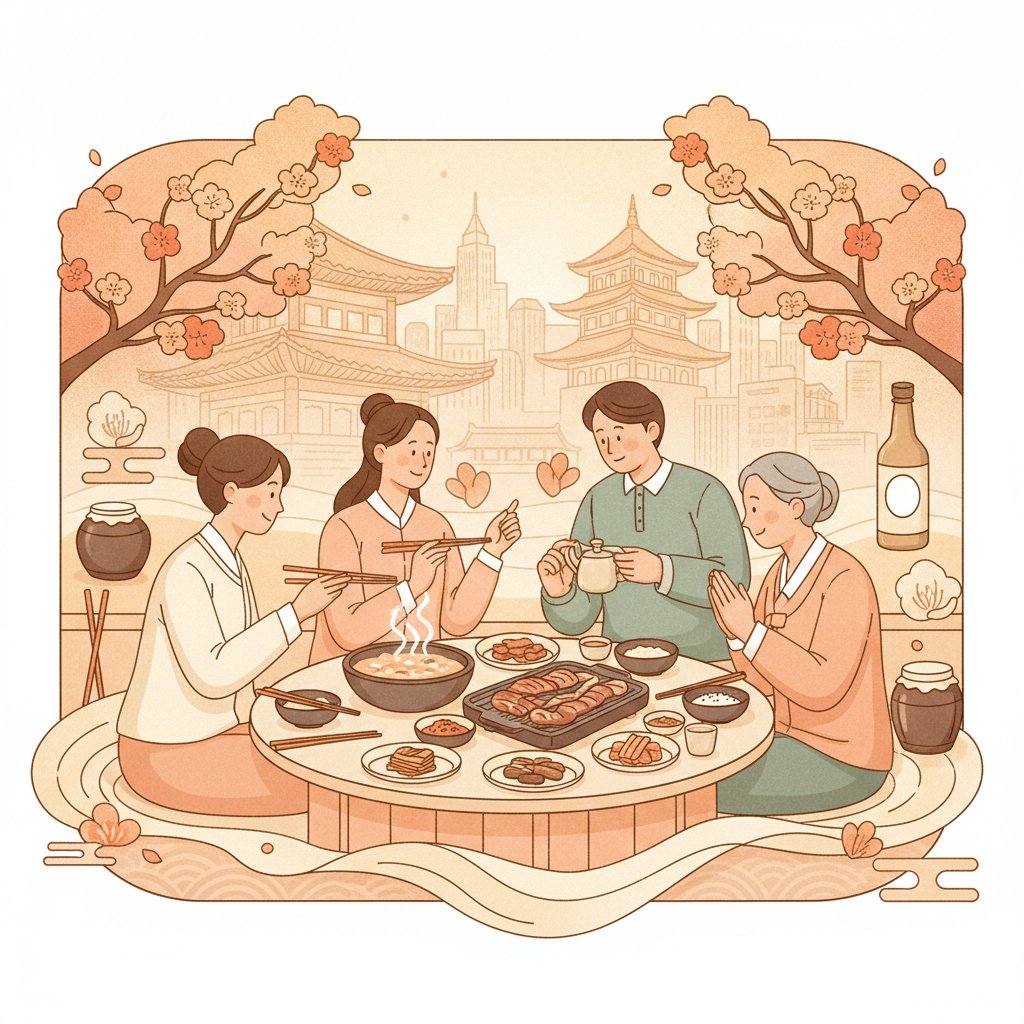
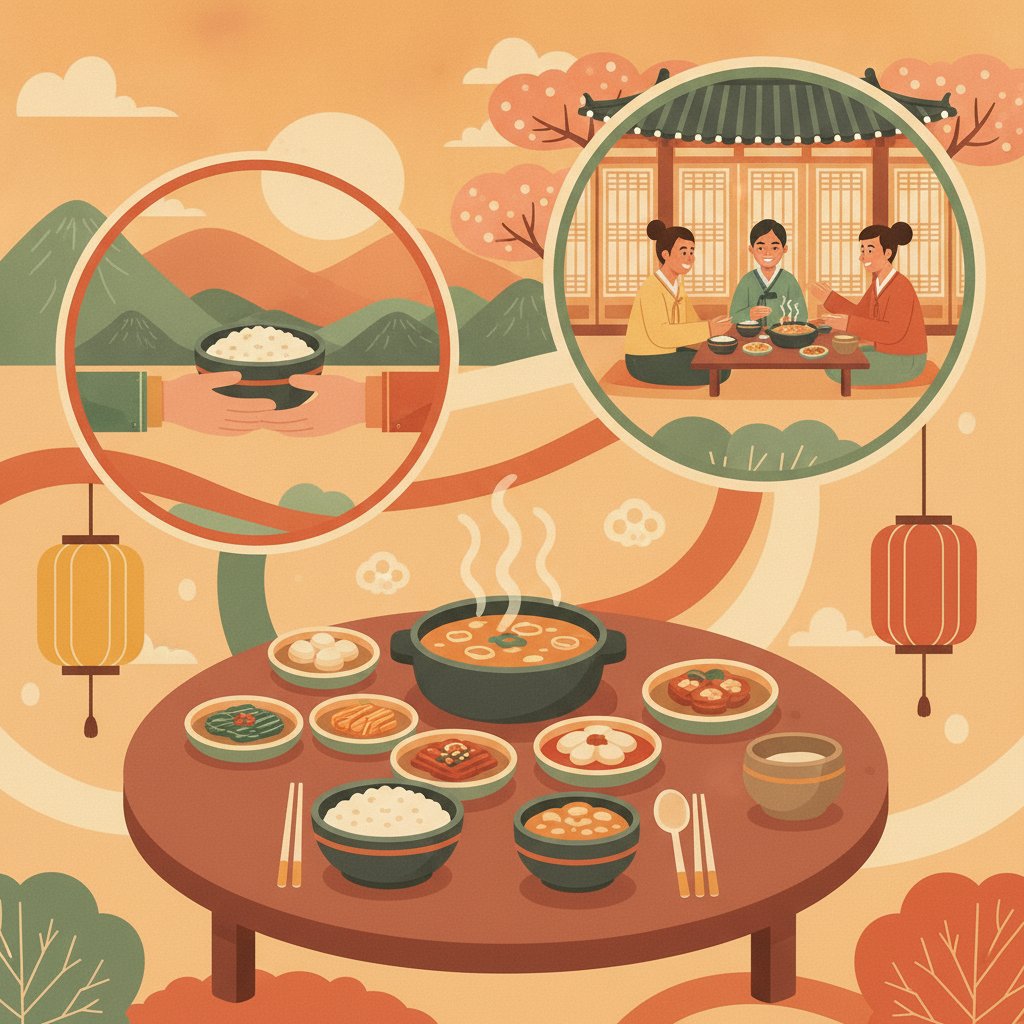
In Korea, using two hands when giving or receiving objects is a sign of respect. This applies directly to the dining table. When someone offers to pour you a drink, hold your glass with both hands (or hold the glass with your right hand while lightly supporting your right forearm or wrist with your left hand). When pouring a drink for someone else, hold the bottle with both hands as well.
Pouring for Others First
It is customary never to pour your own alcoholic drink. Instead, keep an eye on your dining partners’ glasses. When a companion’s glass is empty, offer to refill it. They will usually return the favor immediately by refilling yours. If you do not wish to drink alcohol, it is perfectly fine to accept the first glass out of courtesy and simply leave it full, or accept a fill of water or soda using two hands instead.
Turning Away When Drinking with Elders
If you are drinking with someone older or higher in social standing, turn your face slightly away from them and cover your mouth slightly with your hand when taking a sip. Direct face-to-face drinking with elders can be seen as overly informal in traditional settings.
Paying the Bill and Navigating Meal Costs
Understanding how payments work in South Korea helps prevent awkward moments at the end of a satisfying meal.
No Tipping Required
There is strictly no tipping culture anywhere in South Korea. Tipping is not expected in casual eateries, high-end restaurants, cafes, or bars. Service charges and value-added taxes (VAT) are included in the price listed on the menu. If you leave cash on the table, the staff will likely run after you to return the money you forgot.
How to Pay Your Bill
Servers rarely bring the final payment machine or cash register directly to your table at the end of a meal. Instead, look for a small plastic clip or paper bill left on your table when the food was served. When you are finished eating, take this bill sheet to the payment counter located near the front exit of the restaurant.
Most restaurants in Korea accept international credit cards (Visa and Mastercard are widely accepted), as well as cash and local payment apps. Splitting the bill evenly between credit cards is common and handled easily at the front register.
Typical Restaurant Pricing Context
To help you budget your culinary adventures across South Korea, meal prices generally follow predictable ranges depending on the restaurant style:
| Meal Type | Approximate Price Range (KRW) | Approximate Price Range (USD) |
|---|---|---|
| Casual Street Food / Gimbap Shops | 4,000 – 9,000 KRW | $3 – $7 USD |
| Standard Lunch / Stews (Single Portion) | 8,000 – 15,000 KRW | $6 – $12 USD |
| Korean BBQ (Pork Belly, per serving) | 15,000 – 22,000 KRW | $11 – $17 USD |
| Korean BBQ (High-grade Beef / Hanwoo) | 35,000 – 70,000+ KRW | $26 – $53+ USD |
Note that actual prices vary depending on the neighborhood, ingredient quality, and current economic conditions. High-traffic tourist areas like Myeongdong or Gangnam may sit at the higher end of these estimates.
Frequently Asked Questions
Do you tip at restaurants in Korea?
No, tipping is not practiced in South Korea. Excellent service and tax are already factored into the prices listed on the menu, and attempting to leave a tip can confuse restaurant staff.
Is it rude to leave food on your plate in Korea?
While finishing your meal is appreciated as a sign that you enjoyed the food, leaving a small amount of food behind is not considered offensive. However, taking excessive side dishes from a self-service bar and leaving them completely untouched is discouraged to reduce food waste.
How do you politely get a waiter’s attention in Korea?
Look for a call button attached to the top or side of your table and press it once. If there is no button, call out firmly with Jeogiyo (“Excuse me”) or Sajangnim (“Boss”). Raising your hand while saying this is standard practice across Korea.
🎟️ Popular tours & experiences in Korea
Klook.comMore on Practical Travel Tips
- Korea Internet: eSIM, SIM Card & Pocket WiFiA guide to mobile connectivity options including eSIMs and physical SIM cards for travelers in Korea.
- Why Naver Map Beats Google Maps in KoreaAn explanation of why Naver Map is more accurate and useful than Google Maps for traveling in South Korea.
- Korean Jjimjilbang Sauna Etiquette GuideA step-by-step beginner guide explaining customs, rules, and steps for visiting a Korean jjimjilbang.
See every Practical Travel Tips post in our K-Travel guide.
Handy toolsKorea travel essentials · Trip budget calculator · Korea Guide Finder
Keep Reading
- Seoul Subway Guide for Tourists: Tips From a Local
- Real Escape Challenge (리얼 이스케이프 챌린지): Seoul Review
- Euljiro Nogari Alley (을지로 노가리골목): A Local’s Guide
- Seongbuk-dong–Bukchon Hanok Village Course (성북동고택북촌산책길): A Local’s Guide
🎟️ Popular tours & experiences in Korea
Klook.com