Busan in Two Days: A Local’s Realistic Itinerary for First-Timers
At a glance
- In shortA practical two-day travel itinerary and guide for first-time visitors exploring Busan.
- Best forFirst-time visitors planning a short trip to Busan
- WhereBusan
- Key pointsKTX is the fastest way from Seoul to Busan, taking 2.5 to 3 hours. · Day 1 covers Gamcheon Culture Village, Jagalchi Market, and Gwangalli Beach. · A T-Money card works for seamless travel on Busan's subways and buses.
- Heads-upGamcheon Culture Village has steep hills and active residents, so respect privacy.
Busan in Two Days: A Local’s Realistic Itinerary for First-Timers
Annyeonghaseyo, travel buddies! It’s your local friend from Seoul & Beyond, here to whisk you away to Korea’s vibrant second city, Busan. While Seoul offers a dynamic blend of tradition and modernity, Busan is a breath of fresh air with its stunning coastline, bustling markets, and unique cultural charm. As a Korean, I often find myself drawn to Busan for a quick getaway, a place where the mountains meet the sea in the most spectacular way.
Planning a Busan itinerary can feel a bit overwhelming, especially with so much to see and do. But don’t worry! I’ve crafted a realistic, two-day itinerary that balances sightseeing with genuine local experiences, ensuring you get a true taste of this incredible city without feeling rushed. This isn’t about hitting every single spot, but rather experiencing the essence of Busan, from its vibrant alleys to its serene temples perched by the sea.
Getting to Busan: Your Gateway to the South
Most travelers arrive in Busan from Seoul, and the fastest, most convenient way is by KTX (Korea Train eXpress). The journey from Seoul Station to Busan Station takes roughly 2.5 to 3 hours, offering scenic views as you speed south. It’s advisable to book your tickets in advance, especially during peak seasons or holidays. For those on a tighter budget or with more time, intercity buses are also an option, taking around 4-5 hours from various bus terminals in Seoul.
Getting Around Busan: Navigating Like a Local
Busan boasts an excellent public transportation system. The subway is your best friend for getting around most major tourist spots. Make sure to grab a T-Money card (rechargeable transportation card) from any convenience store upon arrival; it works for both subway and bus and makes traveling much smoother. For places slightly off the subway line, like Haedong Yonggungsa Temple or Gamcheon Culture Village, a combination of subway and bus will get you there efficiently. Taxis are also readily available and reasonably priced compared to many Western cities, especially for short distances or when traveling in a group.
Where to Stay: Base Camps in Busan
Busan offers a variety of accommodation options, each with its own vibe:
- Nampo-dong/Jagalchi Market: Great for first-timers who love bustling markets, street food, and proximity to historical sites. It’s very central and walkable.
- Seomyeon: Busan’s commercial hub, offering endless shopping, dining, and nightlife. It’s a fantastic choice if you want to be well-connected by subway to all corners of the city.
- Haeundae/Gwangalli: Perfect for beach lovers and those seeking modern amenities, upscale dining, and vibrant nightlife with stunning ocean views.
Choose your base camp based on your travel style!
✈️ Book your trip to Korea — hotels, flights & more
Day 1: Coastline Charms & Cultural Kaleidoscope
Morning: Immerse Yourself in Gamcheon Culture Village
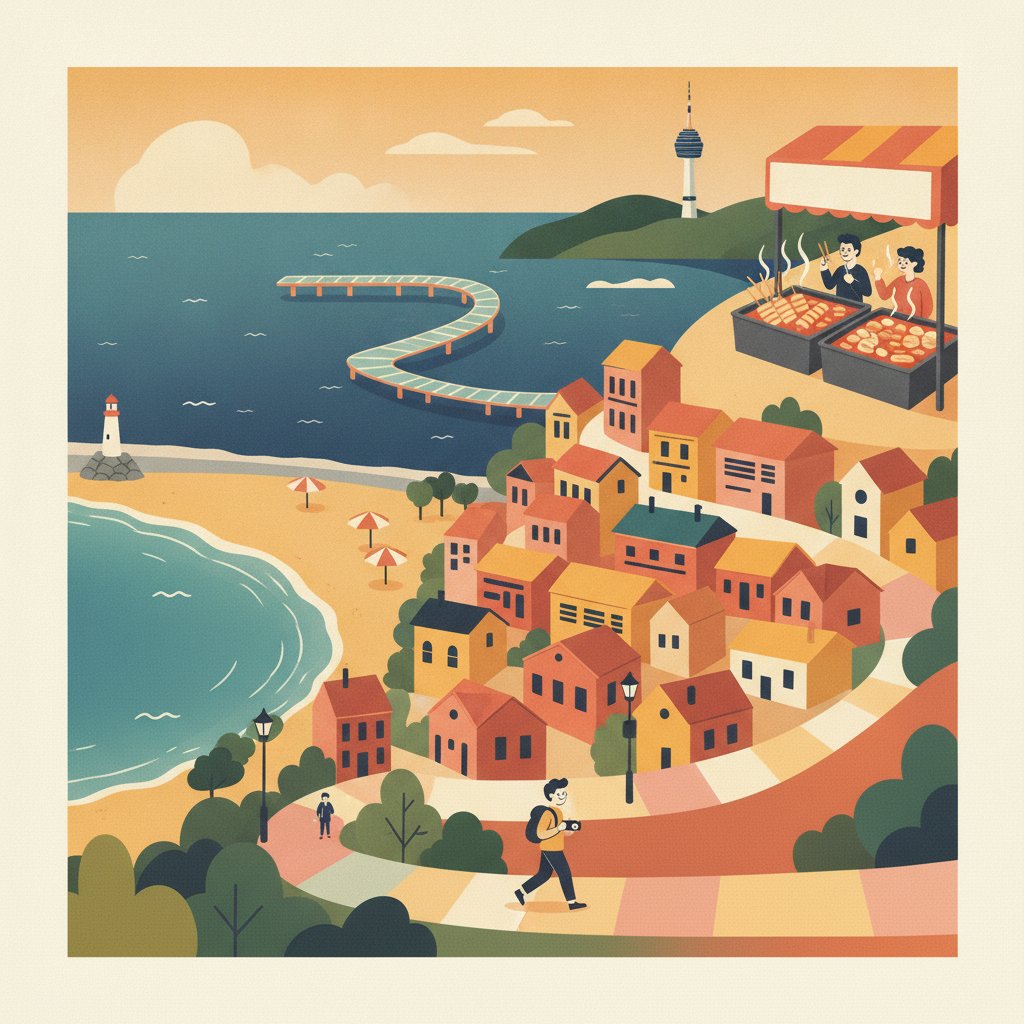
Kick off your Busan itinerary day 1 at one of the city’s most iconic spots: Gamcheon Culture Village. Often called the “Machu Picchu of Busan” or “Santorini of Korea,” this hillside village is a kaleidoscope of brightly painted houses, quirky art installations, and narrow, winding alleyways. It’s a truly unique place that showcases how an old village can be transformed into a vibrant cultural hub.
- How to get there: Take Busan Subway Line 1 to Toseong Station (토성역), Exit 6. From there, you can either take a short taxi ride (about 5 minutes) or catch a local mini-bus (maeul bus) Saha 1-1, Seogu 2, or Seogu 2-2 from the bus stop right outside the exit.
- What to do: Wander through the labyrinthine streets, hunt for the famous “Little Prince and the Fox” photo spot, browse unique souvenir shops, and discover hidden cafes with fantastic views. As a local, I recommend getting the village map from the information center at the entrance; it helps you navigate and find stamp-collecting spots, which is a fun way to explore!
- Local Tip: Wear comfortable shoes! You’ll be doing a lot of walking up and down hills. Also, remember that people still live here, so be respectful of their privacy.
Lunch: Seafood Extravaganza at Jagalchi Market & Nampo-dong Delights
After your morning stroll, head down to Jagalchi Fish Market (자갈치시장), Korea’s largest seafood market. It’s a sensory overload in the best way possible! You’ll see everything from live octopus and huge crabs to exotic fish, all caught fresh from the sea.
- How to get there: From Gamcheon, take a local bus back to Toseong Station, then it’s just one stop on Line 1 to Jagalchi Station (자갈치역). The market is right outside Exit 10.
- What to order: This is where you experience fresh Korean seafood at its best. On the first floor, choose your live fish or seafood. A vendor will help you. Don’t be shy to haggle a little, it’s part of the experience! Once you’ve made your selection, they’ll guide you to an upstairs restaurant where they’ll prepare it for you. Popular options include hoe (회 – sliced raw fish), maeuntang (매운탕 – spicy fish stew), or grilled fish.
- Local Etiquette: While bargaining is common, be polite and friendly. Pointing to the specific seafood you want and asking “Eolmayeyo?” (얼마예요? – How much is it?) is perfectly fine.
Right next to Jagalchi is Nampo-dong and BIFF Square. After lunch, take a stroll here. BIFF Square is famous for its handprints of movie stars and its fantastic street food scene. Try Ssiat Hotteok (씨앗호떡 – sweet Korean pancake filled with seeds) – it’s an absolute must-try Busan specialty!
Afternoon: Coastal Views at Taejongdae Park
For a refreshing afternoon, make your way to Taejongdae Park (태종대유원지), a natural park known for its dramatic cliffs, dense forest, and a picturesque lighthouse overlooking the ocean. It’s a designated national monument and offers breathtaking views of the sea, often including Daema Island (Tsushima, Japan) on clear days.
- How to get there: From Nampo-dong, take bus no. 8, 30, 88, or 101 directly to Taejongdae Park. The bus ride takes about 30-40 minutes.
- What to do: You can explore the park’s main attractions by riding the “Danubi Train” (usually 3,000-5,000 won for adults, please double-check current prices at the entrance) which makes stops at key viewpoints, or if you’re up for a walk, follow the paved paths. Don’t miss the Yeongdo Lighthouse and the Sinseon Rock!
- Local Tip: The last train usually departs around 5:30 PM, so plan your visit accordingly.
Evening: Gwangalli Beach & Millak Raw Fish Town
As the sun sets, head towards Gwangalli Beach (광안리해수욕장). This beach is famous for its stunning night view of the Gwangan Bridge (Diamond Bridge), which lights up in a dazzling display of colors.
- How to get there: Take Busan Subway Line 2 to Gwangan Station (광안역), Exit 3 or 5. The beach is a short walk away.
- Dinner: For dinner, you have a couple of options. You can find numerous restaurants along the beach promenade offering various Korean and international cuisines. For another authentic seafood experience, head to Millak Raw Fish Town (민락회타운) at the far end of Gwangalli Beach. Similar to Jagalchi, you can choose your fresh fish on the first floor and have it prepared upstairs in one of the many restaurants. It’s a fantastic spot to enjoy hoe with a view of the illuminated bridge.
- Evening Stroll: After dinner, enjoy a leisurely walk along the sandy shore, perhaps grabbing a coffee or a local craft beer from one of the cafes overlooking the bridge. The atmosphere here is truly magical at night.
Day 2: Serene Temples, Modern Shores & Scenic Views
Morning: Haedong Yonggungsa Temple – The Temple by the Sea
Start your second day with a visit to one of Korea’s most unique temples, Haedong Yonggungsa Temple (해동 용궁사). Unlike most Korean temples nestled in the mountains, this beautiful Buddhist temple is situated directly on the coastline, offering spectacular ocean views and a distinct spiritual atmosphere.
- How to get there: Take Busan Subway Line 2 to Haeundae Station (해운대역), Exit 7. From there, take bus no. 181 directly to the temple entrance (bus ride usually takes about 20-30 minutes).
- What to do: Explore the main temple complex, cross the picturesque bridge, make a wish at the various Buddha statues, and admire the stunning coastal scenery. Don’t miss the 108-step staircase leading down to the main sanctuary and the golden Haesu Gwan-eum Daebul (Bodhisattva of Mercy) statue overlooking the sea.
- Local Tip: This temple can get quite crowded, especially on weekends and holidays. Try to arrive early in the morning for a more peaceful experience.
Lunch: Haeundae Beach Vibes
After your serene temple visit, head back towards the bustling area of Haeundae Beach (해운대해수욕장). It’s one of Korea’s most famous beaches, popular for its wide sandy shore and vibrant atmosphere.
- How to get there: Take bus no. 181 back to Haeundae Station.
- What to eat: Haeundae offers a plethora of dining options. You can find anything from traditional Korean restaurants serving Dwaeji Gukbap (돼지국밥 – Busan’s famous pork soup with rice, a must-try local dish!) to international cuisine. Many restaurants near the beach specialize in seafood, of course.
Afternoon: Dongbaek Island & The Bay 101
Post-lunch, enjoy a leisurely stroll along Haeundae Beach and then make your way to Dongbaek Island (동백섬), located at the western end of Haeundae Beach. Despite its name, Dongbaek Island is now connected to the mainland. It offers a beautiful coastal walking path with stunning views of the beach, the Gwangan Bridge, and the iconic Nurimaru APEC House.
- What to do: Follow the picturesque walking trail around the island. The APEC House, a memorial hall from the 2005 APEC Summit, is also worth a quick visit for its architecture and panoramic views.
- The Bay 101: As the afternoon progresses, head to The Bay 101, a popular yacht club and dining complex located right next to Dongbaek Island. It’s famous for its stunning night views of Marine City’s skyscrapers reflected in the water. Grab a coffee or some delicious fish and chips from one of the casual eateries and soak in the chic atmosphere.
Evening: Marine City Glamour or Centum City Delights
For your final evening in Busan, you have two excellent options, depending on your preference:
- Option A: Marine City (마린시티)
- Just across from The Bay 101, Marine City is Busan’s answer to Manhattan. It’s an ultra-modern residential and commercial district filled with towering skyscrapers. It’s a great place for a fancy dinner with spectacular city and ocean views. Walk along the waterfront and marvel at the architecture.
- How to get there: A short walk from The Bay 101 or Dongbaek Island.
- Option B: Centum City (센텀시티)
- For serious shoppers and foodies, Centum City is a must-visit. It’s home to the Shinsegae Centum City, recognized by Guinness World Records as the world’s largest department store. Beyond shopping, it boasts a fantastic food court, numerous restaurants, and even a luxurious jjimjilbang (Korean spa), Spa Land Centum City, if you’re looking to relax and unwind.
- How to get there: Take Busan Subway Line 2 to Centum City Station (센텀시티역).
- Local Tip: If you choose Spa Land Centum City (entrance usually 15,000-20,000 won for adults for a few hours, please check current pricing), it’s a perfect way to experience Korean spa culture and relax after two days of exploration before heading back to your accommodation.
🎟️ Popular tours & experiences in Korea
Klook.comBusan Foodie Must-Tries (Beyond the Itinerary)
While our Busan itinerary already includes some fantastic food experiences, here are a few other local specialties you absolutely shouldn’t miss:
- Dwaeji Gukbap (돼지국밥): A hearty pork soup with rice, a Busan signature dish. Warm, comforting, and incredibly flavorful.
- Milmyeon (밀면): A cold noodle dish, similar to Naengmyeon but made with wheat flour noodles. Perfect on a hot day.
- Eomuk (어묵): Fish cakes! You’ll find them everywhere, from street stalls to specialized shops. Samjin Amook (삼진어묵) is a famous brand to try.
- Gopchang (곱창): Grilled beef or pork intestines. A popular choice for a lively dinner with friends, often paired with soju.
A Few More Local Tips for Your Busan Adventure
- Comfortable Shoes are Key: Busan involves a lot of walking, especially at places like Gamcheon Village and Taejongdae.
- Stay Hydrated: Especially in summer, carry a water bottle. Convenience stores are plentiful for refills.
- Learn Basic Korean Phrases: While many younger Koreans and those in tourist areas speak some English, knowing phrases like “Annyeonghaseyo” (Hello), “Gamsahamnida” (Thank you), “Juseyo” (Please give me), and “Eolmayeyo?” (How much is it?) will go a long way.
- Be Mindful of Local Hours: While major attractions are open daily, some smaller shops or restaurants might have specific closing days or hours. Always double-check online before heading out. Prices and operating hours can change, so a quick search before your visit is always a good idea!
- Safety First: Busan is generally a very safe city, but always be aware of your surroundings, especially at night.
There you have it – my local’s guide to a fulfilling and realistic two-day Busan itinerary. It’s a city that truly has something for everyone, from serene temples and stunning beaches to vibrant markets and modern skyscrapers. I hope this guide helps you explore the charm of Busan and create unforgettable memories. Enjoy your trip, and don’t forget to share your adventures with us!
More on Busan Travel Guides
- F1963: Busan's Regenerated Cultural ComplexAn overview of F1963 in Busan, covering its history, art spaces, cafes, cost, and tips.
- B-Con Ground: Busan's Underpass Creative HubAn introduction to B-Con Ground, a creative cultural complex and urban renewal project in Busan.
- Busan Cine Road GuideA guide to visiting Busan Cine Road, featuring thematic film zones and Gwangandaegyo Bridge views.
See every Busan Travel Guides post in our K-Travel guide.
Handy toolsKorea travel essentials · Trip budget calculator · Korea Guide Finder
Keep Reading
- Making the Most of Your Jeonju Day Trip from Seoul
- Sogeumsan Mountain Grand Valley (소금산그랜드밸리): A Local’s Guide
- Hado Fishing Village (하도어촌체험마을): Your Jeju Experience
- Mangmidangil Street (망미단길): A Local’s Guide to Busan’s Hidden Gem
🎟️ Popular tours & experiences in Korea
Klook.com