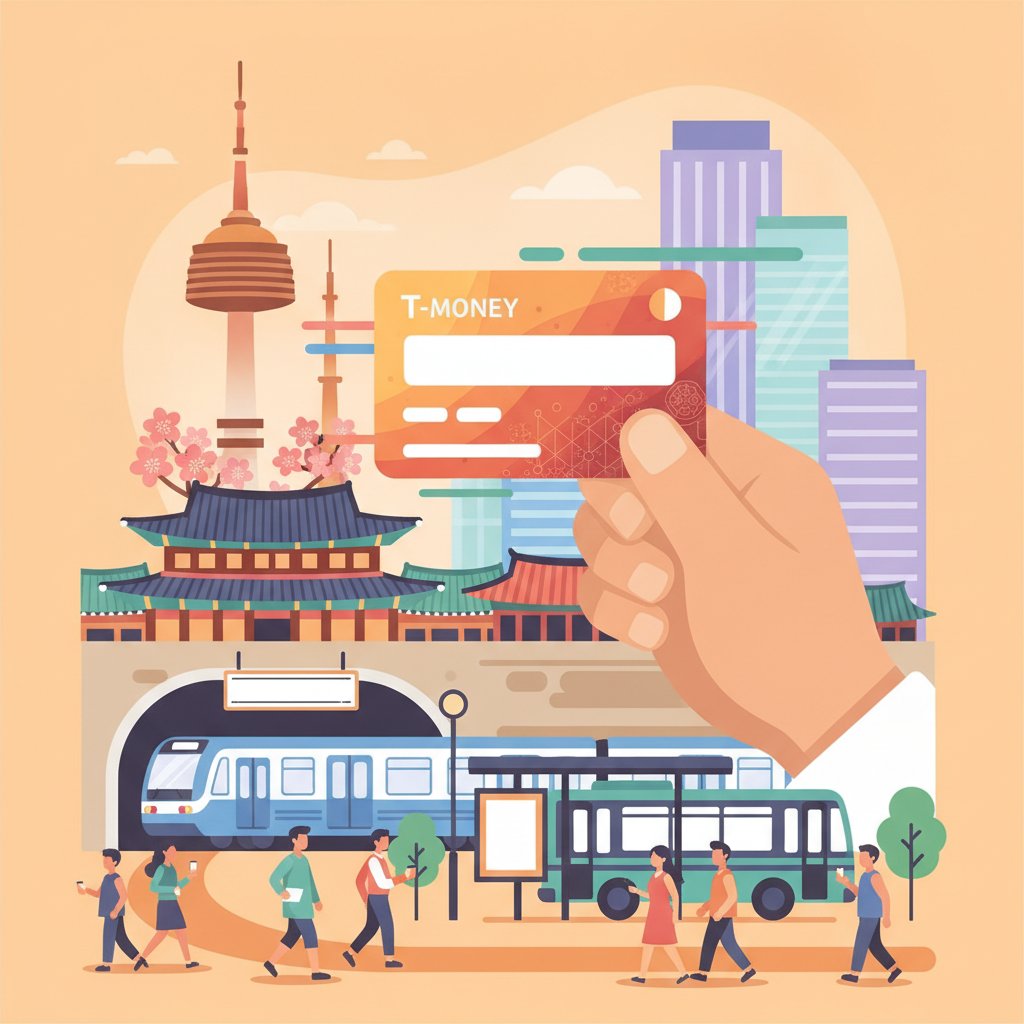
How to Use T-Money Card in Korea for Easy Seoul Travel
At a glance
- In shortA practical guide to buying, topping up, and using T-money transit cards for public travel in Seoul.
- Best forFirst-time visitors and travelers navigating Seoul
- WhereSeoul
- Key pointsT-money cards cost 3,000–10,000 KRW and work on subways, buses, and taxis. · Standard cards must be topped up using physical Korean cash (KRW). · Always tap off buses and subways to get free or discounted transfer rates. · Unused balance under 20,000 KRW can be refunded at convenience stores.
- Heads-upTopping up T-money cards requires physical Korean cash; credit cards are not accepted.
Standing in front of the subway turnstile at Incheon Airport while watching three train cars pull away is a classic first-day scene for visitors arriving in Seoul. As a Korean who takes the subway every single day to get around the city, I always notice travelers searching through their wallets for physical cash or credit cards when all they really need is one small piece of rechargeable plastic: a T-money card.
Korea’s capital operates almost entirely on a digital, contactless transit ecosystem. While you can technically buy single-journey paper tokens for subways, they are inconvenient, require cash deposits, and do not work on city buses. If you want to move around Seoul seamlessly—and save money while doing it—learning how to use T-money card in Korea is the very first travel skill you should master after landing.
What Is a T-Money Card and Why Do You Need One?
A T-money card is a rechargeable contactless smart card used primarily for public transportation across South Korea. Think of it as Seoul’s version of London’s Oyster card or Tokyo’s Suica. You tap it on electronic readers when entering and exiting subway turnstiles, getting on and off buses, or paying for short taxi rides.
As a local, I rarely see anyone pay with cash on transit anymore. In fact, Seoul has been phasing out cash payments on city buses entirely. Without a T-money card (or a similar transit card), riding public transport becomes significantly more complicated. Beyond transit, T-money cards are accepted at thousands of convenience stores, vending machines, public lockers, and select fast-food outlets nationwide.
✈️ Book your trip to Korea — hotels, flights & more
Where to Buy Your T-Money Card
Buying a T-money card is extremely simple because they are sold everywhere. You do not need to show a passport or fill out registration forms to buy a standard card.
1. Airport Convenience Stores and Service Desks
Right after clearing customs at Incheon International Airport (Terminals 1 and 2) or Gimpo Airport, walk up to any convenience store inside the terminal. Major chains include CU, GS25, Seven-Eleven, and Emart24. You can also pick up pre-ordered cards at airport travel counters or through booking platforms like Klook if you ordered a customized tourist package in advance.
2. Neighborhood Convenience Stores
If you miss the airport counters, do not worry. Virtually every convenience store in South Korea stocks T-money cards behind the register. Simply walk up to the cashier and ask for a “T-money card.”
3. Subway Station Vending Machines
Inside nearly every Seoul subway station, you will find automated card-issuing machines located near the ticket gates. These machines feature English, Japanese, and Chinese language menus on screen.
Standard T-money cards typically cost between 3,000 and 5,000 won (roughly $2.20 to $3.80 USD) for the empty card itself. Special themed cards featuring K-pop idols, Line Friends, Sanrio characters, or custom artwork can cost between 6,000 and 10,000 won (roughly $4.50 to $7.50 USD). Keep in mind that purchasing the card only covers the physical plastic—you must add cash balance to it before you can start riding.
Card Options Compared
| Card Type | Approximate Price | Best Suited For |
|---|---|---|
| Standard T-Money | 3,000–5,000 KRW | General tourists |
| Character T-Money | 6,000–10,000 KRW | Souvenir hunters |
| Korea Tour Card | 4,000 KRW | Tourists wanting discounts |
🎟️ Popular tours & experiences in Korea
Klook.comHow to Top Up Your T-Money Card
Here is the most important rule that surprises almost every first-time visitor: you must use physical cash (Korean Won) to top up a standard T-money card. Foreign credit cards, Apple Pay, and digital wallets are not accepted at top-up machines or convenience store cash registers for card reloads. Make sure you withdraw or exchange a modest amount of cash at the airport or an ATM upon arrival.
Method 1: Top Up at Subway Station Machines
- Walk up to any multi-language ticket reloader machine inside a subway station.
- Select “English” on the touch screen.
- Select the “Reload Transit Card” option.
- Place your T-money card onto the designated sensor pad (usually illuminated in green or yellow).
- Select the amount of money you want to add (e.g., 5,000 KRW, 10,000 KRW, 20,000 KRW).
- Insert Korean banknotes into the cash slot.
- Wait a few seconds for the machine to update the balance, then collect your card.
Method 2: Top Up at Convenience Stores
Hand your T-money card and cash to the clerk at CU, GS25, Seven-Eleven, or Emart24. You can say “Chung-jeon hae-ju-se-yo” (Please top this up) or simply hold up the card alongside your cash. The cashier will place your card on their scanner, key in the amount, and hand your card back within five seconds.
For a typical 4 to 5-day trip in Seoul, loading 20,000 to 30,000 won (roughly $15 to $23 USD) is usually enough to cover routine subway and bus journeys.
How to Use T-Money Card in Korea Step-by-step
Once your card has cash loaded, riding public transport in Korea becomes second nature. Here is how to navigate each mode of transit properly.
Riding the Seoul Subway
When entering the station, approach the turnstile barrier. Place your card flat against the card reader (marked with a T-money or contactless logo). The reader will beep once and display two numbers on screen: the top number shows the fare deducted for that trip, and the bottom number shows your remaining card balance. Walk through the gate. When exiting at your destination station, tap your card on the exit gate reader to open the barrier.
Riding Seoul City Buses
Board the bus through the front door. Tap your card against the reader located near the driver until it beeps. When preparing to get off, walk to the middle or rear exit door and tap your card on the exit reader before stepping off.
As a local, I cannot emphasize this enough: always tap off when exiting the bus. Tapping off activates transfer discounts and ensures you are not charged maximum distance penalties for your ride.
Transfer Discounts Explained
One of the greatest features of Korea’s transit system is the free transfer system. When you use a T-money card, transfers between subways and buses (or between different bus routes) are discounted or completely free within a 30-minute window (extended to 60 minutes from 9:00 PM to 7:00 AM). You can stack up to four transfers on a single journey, provided you tap off every time you switch vehicles.
Paying for Taxis
Virtually all modern Korean taxis accept T-money as payment. When you reach your destination, tell the driver you want to pay with T-money. Tap your card on the payment terminal situated between the front seats or on the dashboard passenger terminal. If your balance covers the full metered fare, the payment processes instantly.
Using T-Money Beyond Public Transport
Your T-money card is essentially a micro-prepaid card. If you find yourself holding extra balance near the end of your trip, you can use it to pay for items at:
- Convenience stores (CU, GS25, Seven-Eleven, Emart24)
- Vending machines at subway stations and tourist spots
- Coin-operated luggage lockers inside major stations
- Select fast-food chains and coffee shops (e.g., Lotteria, Paris Baguette)
Simply inform the staff that you wish to pay with T-money before they process your bill.
How to Get a Refund on Unused Balance
If you are leaving Korea and have remaining funds on your card, you do not have to leave that money behind. You can request a cash refund for balances up to 20,000 won at major convenience stores (CU, GS25, Seven-Eleven). The cashier will return your remaining cash minus a small processing fee of 500 won (about $0.38 USD). The physical card remains yours to keep as a souvenir or for your next trip to Korea, as T-money balances never expire.
🎟️ Popular tours & experiences in Korea
Klook.comFAQ
Can I buy or top up a T-money card with a foreign credit card?
You can buy the empty card at select retail counters using a credit card, but topping up cash onto standard T-money cards requires Korean cash (KRW). Always keep a small amount of paper currency on hand for reloads at subway stations or convenience stores.
How much money should I put on my T-money card for 5 days in Seoul?
A typical subway or bus ride in Seoul costs roughly 1,400 to 1,500 won ($1.00 to $1.15 USD). Loading 20,000 to 30,000 won (approximately $15 to $23 USD) is usually plenty for five days of casual sightseeing across the city.
What happens if I forget to tap my T-money card when getting off the bus?
If you forget to tap off, the transit system cannot calculate your exact travel distance, so you will be charged maximum base fees and lose all transfer discounts for your next ride. Always tap the reader near the rear exit door right before you step off.
More on Transit & Transportation
- Seoul Subway Tips for First-Time VisitorsA guide covering transit cards, navigation apps, and etiquette for riding the Seoul subway.
- T-money Card Buying and Charging GuideA guide explaining how to buy, charge, and use a T-money card for travel in South Korea.
- Seoul Subway Tips for First-Time VisitorsA guide covering T-Money cards, navigation apps, local etiquette, and tips for Seoul's subway system.
See every Transit & Transportation post in our K-Travel guide.
Handy toolsKorea travel essentials · Trip budget calculator · Korea Guide Finder
Keep Reading
- Tipping in South Korea: When to Pay Extra and How to Haggle
- How to Get from Seoul to Jeju: Flights and Ferries
- Han River Instant Ramen Picnic: How to Plan the Perfect Day
- Kakao Taxi Guide for Tourists: How to Book Without a Local Number
🎟️ Popular tours & experiences in Korea
Klook.com