Tipping in South Korea: When to Pay Extra and How to Haggle
A Server Chased Us Down the Street
A few months ago, I was having Korean barbecue at a busy spot in Myeongdong with a friend visiting from the United States. After finishing our pork belly and side dishes, my friend quietly tucked a 10,000-won bill under his empty water glass as a token of gratitude. We paid our bill at the front register and stepped outside. We had barely walked half a block when our server came sprinting down the sidewalk, breathing heavily, holding the bill out to us. She thought we had accidentally left our cash on the table.
My friend was embarrassed, thinking he had broken a rule, while the server was simply relieved to return lost money to a customer. As a Korean born and raised in Seoul, I see this exact misunderstanding happen all the time. Travelers arriving from countries with strong tipping customs often feel uneasy leaving a table without dropping extra cash. However, understanding the rules surrounding tipping in South Korea will make your trip smoother and save you from unnecessary social awkwardness.
✈️ Book your trip to Korea — hotels, flights & more
The Short Answer: Do You Tip in South Korea?
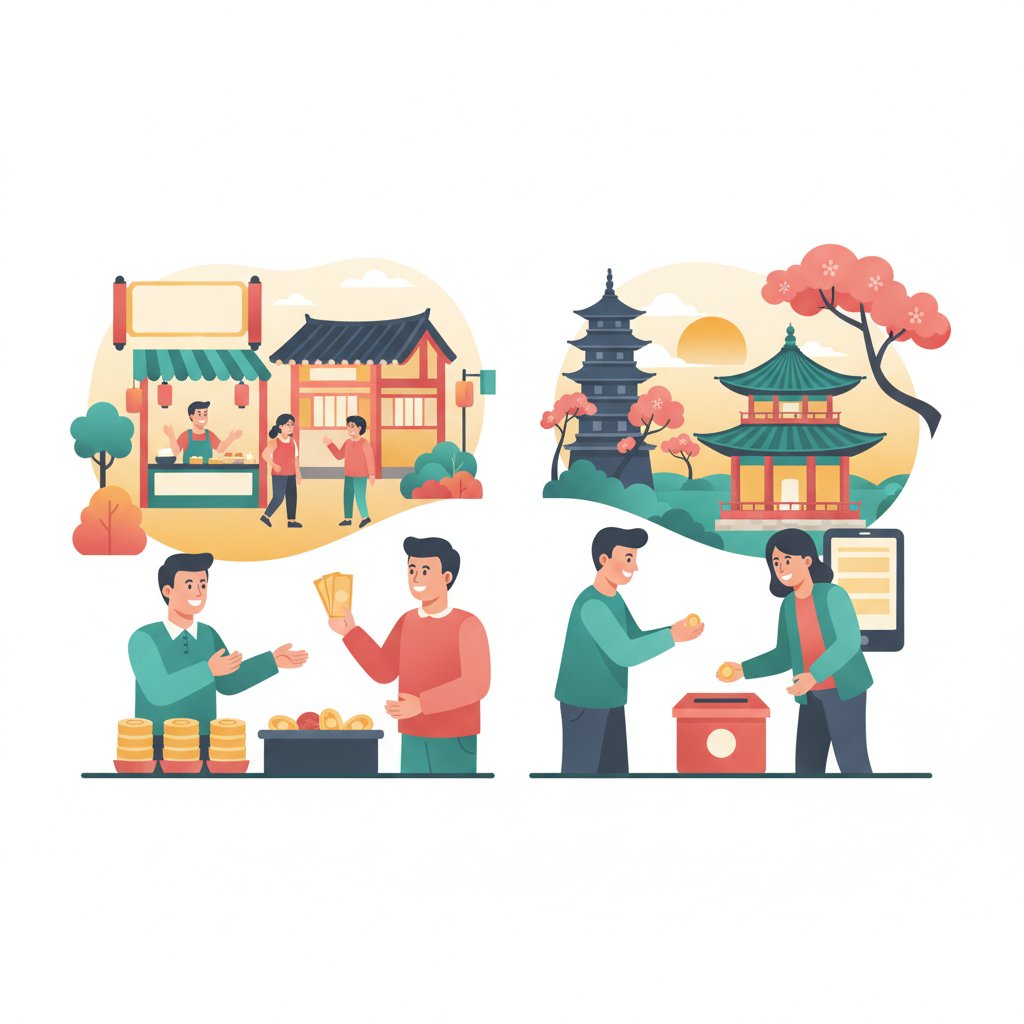
The short answer is no. Tipping is not part of Korean culture, and in almost all everyday situations, it is neither expected nor required. In fact, handing someone extra cash can sometimes cause genuine confusion, awkwardness, or mild distress, as workers may feel obligated to return money that does not belong to them.
Under Korean law, menu prices and bills in restaurants, cafes, and service establishments must include all taxes and service charges. The price you see printed on the menu—whether it is 10,000 won (around $7.50 USD) for a bowl of kimchi stew or 4,500 won (around $3.30 USD) for an iced Americano—is the exact amount you pay. Excellent hospitality is considered a standard part of the job, not something that requires a financial reward from the customer.
Where Tipping Is Non-Existent
- Restaurants and Cafes: Whether you are dining at a casual street stall or an upscale dining spot, leave no cash on the table.
- Taxis: Drivers will give you exact change down to the last 100 won coin.
- Hair Salons and K-Beauty Clinics: Prices for treatments, haircuts, or facials are fixed. Stylists do not expect tips.
- Delivery Services: Food delivery drivers through local apps do not receive cash tips at the door.
Rare Exceptions to the No-Tipping Rule
While standard daily interactions exclude tipping, there are a few niche scenarios where small gratuities or service fees might appear:
- Luxury International Hotels: Five-star international hotel chains in Seoul (like the Grand Hyatt or The Shilla) may include a explicit 10% service charge directly on your room bill or dining receipt. Porter services at these luxury properties might occasionally accept a small gratuity if offered, though it remains optional.
- Private Tour Drivers and Guides: If you book a multi-day private tour through platforms like Klook or custom travel agencies, tipping your guide or private van driver around 10,000 to 20,000 won ($7.50–$15 USD) per day for exceptional service is appreciated, though still not mandatory.
- Traditional Funeral or Wedding Envelopes: While not a tip for service, monetary gifts (called 축의금 for weddings and 조의금 for funerals) presented in crisp white envelopes are an essential part of Korean social life.
Navigating Everyday Scenarios in Seoul
To help you move around Seoul like a local, here is a breakdown of how service interactions function across popular visitor spots.
Dining Out: Self-Service Kiosks and Table Order Screens
Korean dining culture emphasizes efficiency. Many modern restaurants and fast-casual eateries use electronic kiosks at the entrance or digital ordering screens attached to each table. You select your meals, pay by card directly on the screen or terminal, and sit down.
In standard sit-down places where a server brings food to your grill or table, paying cash directly to the server is uncommon. Instead, you usually bring the paper bill sitting on your table up to the front counter near the exit when you finish eating. You pay the exact amount listed. If you pay in cash and want to leave small change behind, the cashier will almost certainly hand it right back to you.
Taking Taxis: Kakao T and Card Payments
Taxis in South Korea are affordable, safe, and efficient. Base fares in Seoul generally start around 4,800 won (roughly $3.60 USD) for standard sedans during regular daytime hours, with night surcharges kicking in after 10:00 PM. Fares vary depending on traffic, region, and time of day.
Most travelers and locals use taxi-hailing apps like Kakao T or simply hail blue, orange, or silver cabs on the street. You can pay with international credit cards, local T-money transit cards, or cash. If your fare comes out to 9,600 won and you hand the driver a 10,000-won note, the driver will press a button on their register to hand you your 400 won in change. If you genuinely want to tell them to keep the change, you can say warmly, “Jandoneun gajigaseyo” (“Please keep the change”), but do not feel obligated to do so.
🎟️ Popular tours & experiences in Korea
Klook.comThe Real Hospitality Language: Understanding “Service” (서비스)
While you won’t be giving tips in Korea, you will frequently receive something called “Service” (pronounced seobiseu in Korean). This is the local version of showing generosity, and understanding how it works will enhance your culinary experiences across the country.
In Korean culture, service refers to complimentary food, drinks, or extra items given to customers as a gesture of goodwill or gratitude for their business. It is anchored in the traditional Korean concept of Jeong (정)—a feeling of warm affection and attachment toward others.
Examples of “Service” You Might Encounter:
- A restaurant owner bringing a free bottle of soda, a side dish of steamed egg (계란찜), or extra dumplings to your table.
- A K-beauty shop putting ten extra sheet masks and skin care samples into your shopping bag at check-out.
- A street food vendor giving you an extra piece of fried rice cake or a cup of warm fish cake broth while you stand in the cold.
When a server sets down a complimentary item and says, “This is service!” do not panic or worry that it will end up on your final bill. It is entirely free. The best way to respond is with a bright smile and a sincere “Gamsahabnida!” (Thank you!).
The Art of Bargaining in South Korea: Where and How
Bargaining—known locally as 흥정 (heungjeong)—follows strict spatial rules in Korea. Trying to negotiate prices in the wrong place can be embarrassing, while failing to ask for a small discount in traditional wholesale hubs means leaving money on the table.
Where Bargaining Is NOT Allowed
In 90% of your retail encounters in Korea, prices are completely fixed. Never attempt to haggle at:
- Department stores (Lotte, Shinsegae, Hyundai)
- Cosmetic retail chains (Olive Young, Chicor)
- Convenience stores (GS25, CU, Seven-Eleven)
- Chain clothing shops (SPA brands, mall stores)
- Supermarkets and grocery stores
- Restaurants, cafes, and bakeries
Where Bargaining IS Expected or Accepted
Bargaining is primarily limited to traditional markets, underground shopping centers, and vintage bazaars. Even in these locations, price adjustments are usually modest—think 10% to 15% off, rather than cutting prices in half.
| Shopping Location | Bargaining Status | Typical Discount Potential |
|---|---|---|
| Traditional Markets | Accepted | 1,000–5,000 won off or extra items |
| Underground Malls | Possible with Cash | 10% off for cash payments |
| Department Stores | Strictly Fixed | None (fixed prices) |
Polite Bargaining Strategies for Travelers
If you are exploring bustling shopping zones like Namdaemun Market, Dongdaemun Shopping Complex, or the Express Bus Terminal Underground Shopping Mall (Goto Mall), here are the best ways to request a lower price without causing offense:
1. Pay with Cash (현금 – Hyeongeum)
Small vendor stalls pay processing fees on credit card transactions. Many sellers in underground malls list two implied prices: standard card price and a slightly discounted cash price. If a shirt is tagged at 15,000 won, you can hold up cash and politely ask if they will take 13,000 or 14,000 won.
2. Buy in Bundles
You have much better leverage when buying multiple items from the same shopkeeper. If you are buying three pairs of socks, two scarves, or multiple K-pop souvenirs, ask for a small total discount or an extra item thrown in for free.
3. Master Essential Korean Phrases
Approaching shopkeepers with respect and a gentle tone goes a long way. Use these polite phrases:
- “Kakka-juseyo” (까까주세요): “Please give me a discount.” (Use this with a friendly smile).
- “Hyeongeum-hayeondweyo?” (현금 하면 돼요?): “Is it cheaper if I pay in cash?”
- “Jom sseage hae-juseyo” (좀 싸게 해주세요): “Please make it a little cheaper for me.”
Remember to keep negotiations lighthearted. If a seller firmly declines your request with a smile or a head shake, accept the original price politely or walk away gracefully with a respectful nod.
Practical Budgeting and Currency Context
To help you navigate purchases confidently, keep these typical daily price ranges in mind when exploring Seoul. Prices fluctuate depending on neighborhood and economic shifts, but these general ranges provide helpful baseline expectations:
- Street Food (Tteokbokki, Hotteok): 3,000 to 6,000 won ($2.20–$4.50 USD)
- Casual Meal (Kimchi Stew, Bibimbap): 8,000 to 12,000 won ($6.00–$9.00 USD)
- Café Latte at an Independent Specialty Shop: 4,500 to 6,500 won ($3.30–$4.80 USD)
- Budget Underground Shopping Apparel: 10,000 to 25,000 won ($7.50–$18.50 USD)
- Basic Facial at a K-Beauty Clinic: 50,000 to 150,000 won ($37.00–$112.00 USD)
By keeping cash on hand for traditional markets and trusting that restaurant prices cover all service fees, you can relax and focus on enjoying your time in Korea without worrying about tip calculations at the end of every meal.
FAQ
Is it rude to tip in South Korea?
It is not necessarily seen as rude or insulting, but it is considered unusual and confusing. In most cases, a server or driver will chase after you to return the cash, believing you accidentally dropped or forgot your money on the table.
Should I tip my tour guide or private driver in Korea?
Tipping tour guides or private drivers is not mandatory. However, if you hire a private guide for an extended custom tour or a full-day excursion booked through travel sites, small tips around 10,000 to 20,000 won ($7.50–$15.00 USD) are welcomed as a voluntary thank-you for exceptional service.
How do I ask for a discount in Korean when shopping at traditional markets?
The simplest and most polite phrase to use is “Kakka-juseyo” (까까주세요), which means “Please give me a discount.” Offering to pay in cash or purchasing multiple items together will significantly increase your chances of receiving a small price reduction.
🎟️ Popular tours & experiences in Korea
Klook.comKeep Reading
- KTX Train Travel: Korea’s High-Speed Rail Tips
- Seoul Subway Tips for First-Time Visitors
- Your Essential T-money Card Guide: A Local’s Tips for Buying and Charging
- Seoul Subway Tips for First Time Visitors
🎟️ Popular tours & experiences in Korea
Klook.com