How to Travel Jeju Island Without Driving
At a glance
- In shortA guide to navigating Jeju Island using public transit, local mapping apps, taxis, and day tours without a car.
- Best forTravelers visiting Jeju without a driver's license
- WhereJeju
- Key pointsColor-coded buses connect Jeju Airport, towns, coastal spots, and attractions. · Naver Map and KakaoMap offer real-time transit tracking and English interfaces. · Standard T-money and Cashbee transit cards are accepted across all Jeju buses.
- Heads-upGoogle Maps has limited walking and transit routing in Korea; use Naver Map or KakaoMap.
Many travelers book a trip to Jeju Island and immediately panic when they discover their international driving permit is expired or that car rental prices have surged. As a Korean who frequently visits Jeju from Seoul without ever renting a vehicle, I can assure you that exploring this beautiful volcanic island using public transit is not only possible, but actually surprisingly relaxing. You do not need to sit behind the wheel to experience Jeju’s stunning coastlines, lush green tea fields, or lively traditional markets.
Back in 2017, the Jeju provincial government completely revamped the island’s transit network, introducing dedicated bus lanes, color-coded routes, and free Wi-Fi on almost all public buses. While driving certainly offers maximum spontaneity, relying on jeju island public transport gives you the chance to sit back, gaze out at the ocean, and travel like a local. Here is everything you need to know to navigate Jeju smoothly without a driver’s license.
Understanding Jeju’s Color-Coded Bus System
The key to mastering Jeju’s bus network is recognizing the color of the vehicle heading toward your stop. Buses are grouped by speed, coverage, and purpose, making it easier to select the right option once you get the hang of the system.
Red Express Buses (100-series)
Red buses are your best friend for long-distance transit across the island. These Express Buses run along the major arteries connecting Jeju International Airport, Jeju City, Seogwipo, and key coastal hubs. They skip minor local stops, making them significantly faster than standard city buses. Fares generally range from 2,000 to 3,000 KRW (roughly $1.50 to $2.30 USD), depending on the distance traveled.
Blue Main Trunk Buses (200-series and 300-series)
Blue buses connect major towns, coastal villages, and popular tourist attractions. They stop more frequently than red buses but cover almost every major spot on the island. Bus 201 (which runs along the east coast) and Bus 202 (which runs along the west coast) are legendary among budget travelers. The flat fare is usually around 1,200 KRW (roughly $0.90 USD).
Green Branch Buses (400-series and 700-series)
Green buses serve local neighborhoods, rural villages, and deep mountain routes around Hallasan. You will likely use these when transferring from a main blue route to reach a specific cafe, trailhead, or quiet beach tucked away from the main highway.
Yellow Tourist Loop Buses (810 and 820)
Designed specifically for travelers, the yellow buses loop around major sightseeing zones. Bus 810 operates in the eastern region (connecting places like Snoopy Garden and various oreums/volcanic cones), while Bus 820 covers the western region. They even feature audio announcements highlighting local points of interest.

✈️ Book your trip to Korea — hotels, flights & more
Essential Navigation Apps for Non-Drivers
If you rely on Google Maps in South Korea, you will quickly realize its walking and transit routing capabilities are severely limited due to local data mapping regulations. To navigate jeju island public transport like a Korean local, you must download local mapping apps before your trip.
Naver Map vs. KakaoMap
Both Naver Map and KakaoMap offer comprehensive real-time bus tracking, English menu interfaces, step-by-step walking routes, and live arrival times. They show you exactly which bus stop to stand at, how many stops remain, and when to press the stop button.
- Naver Map: Widely considered the most user-friendly app for English speakers. It features clean search results and clear instructions for transfers.
- KakaoMap: Excellent for real-time 3D bus tracking and finding smaller local shops or hidden village cafes.
When searching for locations in these apps, typing the destination in Korean (Hangul) yields the most accurate results, though searching in English or using phone numbers works well for major landmarks.
Kakao T for Taxi Hailing
For moments when bus schedules do not line up with your plans, Kakao T is essential. It functions just like Uber or Lyft. You can request standard taxis, pay directly through the app with a registered card, or choose the option to pay the driver directly with cash or a physical credit card at the end of the trip.
Paying Your Fare: Transit Cards and Transfers
You do not need to purchase special single-ride tickets for Jeju buses. The standardized South Korean transit card system works seamlessly across the entire island.
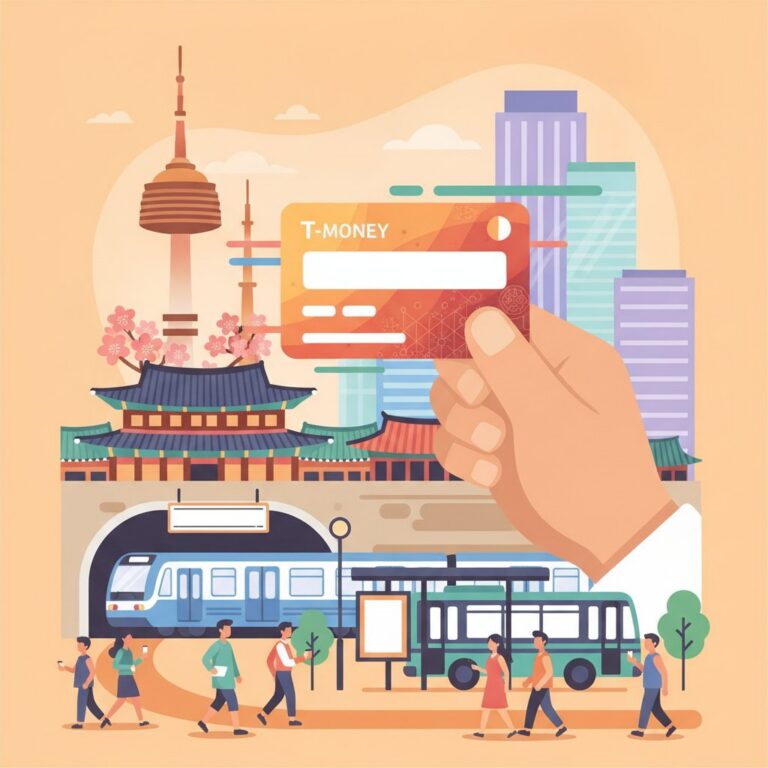
You can purchase a T-money or Cashbee card at any convenience store (such as GS25, CU, or Seven-Eleven) at the airport or near major bus terminals for around 3,000 to 5,000 KRW (roughly $2.25 to $3.80 USD). Once purchased, top up the card with Korean Won cash at convenience store counters or transit card rebalancing machines inside Jeju Airport.
Always tap your card on the card reader near the front door when boarding, and tap again on the reader near the rear door when exiting. Tapping out ensures you receive transfer discounts (up to two free transfers within 40 minutes) and prevents the system from charging you the maximum distance penalty fare.
🎟️ Popular tours & experiences in Korea
Klook.comKey Bus Routes Every Traveler Should Bookmark
While Jeju has dozens of lines, memorizing or saving these core routes will solve 80% of your sightseeing transit needs.
Bus 600: Airport Limousine Bus
If your hotel is located in the southern city of Seogwipo or the Jungmun Tourist Complex, Bus 600 is your most convenient option upon landing. It features ample luggage storage space underneath or near the front entrance. It connects Jeju Airport directly to major resorts like the Shilla, Lotte, and Hyatt, as well as the Seogwipo Olle Market area. Fares typically cost between 3,000 and 5,500 KRW (roughly $2.30 to $4.20 USD).
Bus 101 and 102: Rapid Coastal Express
Bus 101 runs along the northern and eastern coast from Jeju City Bus Terminal to Seogwipo Bus Terminal, stopping at key destinations like Hamdeok Beach and Seongsan Ilchulbong (Sunrise Peak). Bus 102 runs along the western coast, connecting Jeju City to Hallim, Hyeopjae Beach, and southern Seogwipo. These routes allow you to bypass smaller inland villages and travel between major regions in roughly half the time of local buses.
Bus 201 and 202: Scenic Slow Travel
When you are not in a rush and want to hop on and off along popular coastal beaches, switch to Bus 201 (East) or Bus 202 (West). Bus 202, for example, hugs the western coastline, dropping you off right outside popular oceanfront cafes in Aewol, the white sands of Hyeopjae, and the sunset spots of Sinchang Windmill Coastal Road.
Alternative Non-Driving Options: Taxis and Day Tours
Relying purely on buses might limit your ability to visit deep inland destinations like Mount Halla trailheads or remote forest paths early in the morning. Combining public buses with occasional taxis or structured day tours creates a balanced, stress-free itinerary.
Private Charters and Taxi Services
If you are traveling in a group of three or four, hiring a private taxi driver for a full day (usually 8 hours) can be surprisingly economical. Rates typically range from 150,000 to 200,000 KRW (roughly $110 to $150 USD) for the entire group, including gas and parking. The driver takes you anywhere you want on the island, acts as a local expert, and holds your luggage in the trunk while you explore.
Organized Day Tours
For solo travelers who want to avoid route planning altogether, booking small-group day tours via platform services like Klook is a very popular choice. These tours typically focus on specific regions—such as an Eastern Jeju nature tour featuring Seongsan Ilchulbong and Seopjikoji, or a Southern Jeju waterfall and tea garden tour—and include hotel pickup and drop-off.
Bus vs Taxi vs Day Tour Comparison
| Method | Approx. Cost | Best For |
|---|---|---|
| Public Bus | 1,200–3,000 KRW / ride | Budget solo travelers, coastal hops |
| Taxi (Kakao T) | 10,000–35,000 KRW / trip | Short direct trips, late nights |
| Klook Day Tour | 40,000–90,000 KRW / person | Solo travelers, remote inland spots |

Pro Tips for Riding Buses in Jeju
To ensure a smooth journey on jeju island public transport, keep these practical local tips in mind:
- Signal the Driver: If you are standing alone at a rural bus stop, raise your hand slightly or step toward the curb as the bus approaches. If no one signals and no passengers are alighting, drivers may bypass quiet stops.
- Watch the Electronic Display: Most modern Jeju buses feature digital screens at the front displaying upcoming stops in Korean, English, Chinese, and Japanese. Audio announcements are also played in English before major stops.
- Keep Luggage Compact: Standard city buses (Blue/Green) do not have dedicated luggage compartments underneath. If you are traveling with large suitcases, use the Red Express buses or Bus 600, or send your heavy luggage ahead using local luggage delivery services.
- Mind the Evening Schedules: Unlike Seoul, where transit runs late into the night, rural Jeju buses often reduce frequency significantly after 8:00 PM or stop running entirely around 9:30 PM. Always check the last bus departure time on Naver Map when planning evening dinner trips.
🎟️ Popular tours & experiences in Korea
Klook.comFAQ
Is public transport in Jeju reliable for late-night travel?
Public buses on Jeju Island generally decrease in frequency after 8:00 PM, and many rural or green branch lines stop running around 9:00 PM to 10:00 PM. Main Express buses and local city buses in Jeju City or central Seogwipo run slightly later, but for late-night transit, hailing a ride via Kakao T or taking a taxi is recommended.
Can I use my T-money card on Jeju buses?
Yes, standard T-money, Cashbee, and major contactless Korean transportation cards are fully accepted on all Jeju public buses. You can top up your card balance using cash at convenience stores located throughout the island and inside Jeju International Airport.
How much does a taxi cost across Jeju Island?
Taxi fares depend heavily on distance, but a ride within central Jeju City or Seogwipo usually ranges between 5,000 and 12,000 KRW ($3.80 to $9.00 USD). A long-distance taxi ride crossing the island from Jeju International Airport to southern Seogwipo typically costs around 30,000 to 45,000 KRW ($23 to $34 USD), depending on traffic and route.
More on Jeju Island Travel
- How to Travel from Seoul to JejuA guide comparing flights and KTX plus ferry routes for traveling from Seoul to Jeju Island.
- Hado Fishing Village: Jeju Travel GuideAn overview of Jeju's Hado Village, featuring its Haenyeo Museum, bird sanctuary, and peaceful beach.
- Aqua Planet Jeju Visitor GuideA complete guide to Aqua Planet Jeju, featuring scale comparisons, haenyeo shows, and costs.
See every Jeju Island Travel post in our K-Travel guide.
Handy toolsKorea travel essentials · Trip budget calculator · Korea Guide Finder
Keep Reading
- Changkkom: Natural Basalt Window in Bukchon-ri, Jeju
- Gyeongju Travel Guide for First-Time Visitors
- Visiting Busan’s Seaside Haedong Yonggungsa Temple
- Yeongsil Trail (Hallasan National Park) (한라산 영실): A Local’s Guide
🎟️ Popular tours & experiences in Korea
Klook.com