Korean Family Hierarchy in K-Dramas: A Local’s Take
Every Chuseok holiday, my uncle sits at the head of the dining table, and no one touches their chopsticks until he picks up his first bite. As a Korean who grew up in Seoul, this isn’t dramatic television—it is simply how dinner works in our household. Yet when international fans watch shows like Reply 1988, Sky Castle, or Reborn Rich, these strict rules of deference, seating arrangements, and deep filial obligation can seem intensely complex. Understanding the Korean family hierarchy kdrama tropes show on screen reveals that these scenes are rooted in centuries of deep-seated cultural expectations.
While screenwriters certainly exaggerate family feuds for entertainment, the backbone of Korean household structure is genuine. If you have ever felt confused by why a 30-year-old character cowers before their father or why a mother-in-law wields enormous authority, here is an insider look at how real Korean families operate and how television interprets our real-life social codes.
The Confucian Roots of Korean Household Structure
To understand modern Korean family dynamics, you have to look back to Neo-Confucian philosophy, which dominated the Joseon Dynasty for over 500 years. Confucianism established five key human relationships, emphasizing respect for elders, filial piety (hyodo), and strict order within the home. Even in present-day Seoul, surrounded by high-tech skyscrapers and rapid modern trends, these principles remain embedded in our daily lives.
In a traditional Korean household, authority flows strictly downhill based on two factors: age and generation. A father holds authority over his children, an older brother over a younger brother, and an aunt over her nieces and nephews regardless of their individual adult success. This creates a vertical structure where speaking casually or disobeying a senior family member feels like breaking a fundamental law of social decorum.
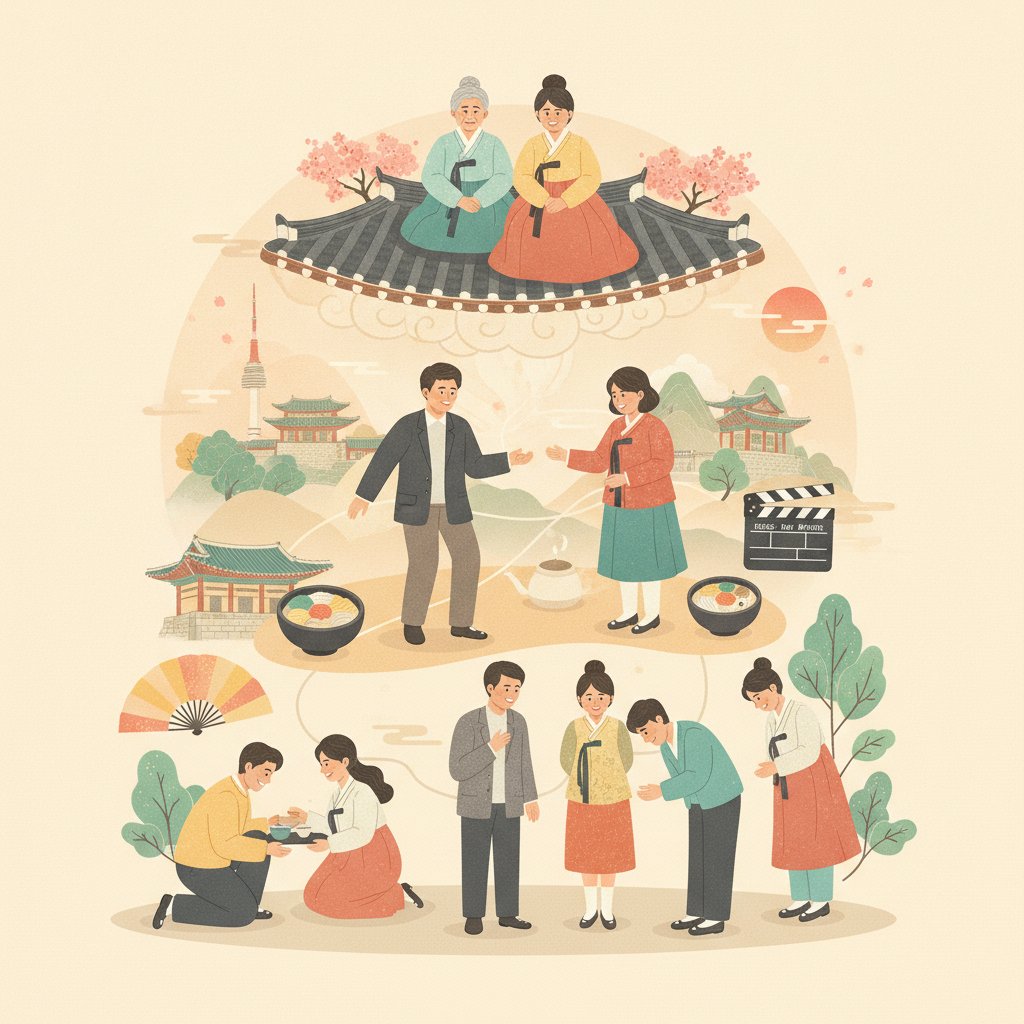
When you see K-drama characters using two hands to pour a drink for an elder, turning their body away to take a sip, or bowing slightly while receiving an object, you are watching real etiquette that we practice every day. In K-dramas, writers use these subtle actions to immediately signal to local viewers who holds the power in a room.
✈️ Book your trip to Korea — hotels, flights & more
Deciphering Titles: Why What You Call Someone Matters
In English, you might call your older brother, younger sister, cousin, and uncle simply by their first names. In Korea, doing so without an explicit invitation is considered rude. Kinship terms are not merely labels; they are social anchors that establish exact roles within the hierarchy.
In K-dramas, the terms characters use—or deliberately refuse to use—tell you everything about their current relationship status. Here is a breakdown of essential family terms you frequently hear on screen:
| Korean Term | Literal Meaning | Social Context |
|---|---|---|
| Hyung / Oppa | Older Brother | Used by males (Hyung) or females (Oppa) for older brothers or close older males. |
| Noona / Unnie | Older Sister | Used by males (Noona) or females (Unnie) for older sisters or close older females. |
| Abeonim / Eomonim | Formal Father / Mother | Polite, respectful address used for parents-in-law or elders. |
When a character suddenly drops formal address (jondetmal) and switches to casual speech (banmal) without permission, it signals a direct challenge to the power dynamic. Conversely, when a daughter-in-law addresses her mother-in-law with elevated honorifics like Eomonim, she is demonstrating respect and maintaining boundaries.
The Heavy Crown of the Eldest Son (Jang-nam)
If you have watched family-centered K-dramas like My Mister or Once Again, you may have noticed the disproportionate focus placed on the eldest son, known as the jang-nam. Traditionally, the eldest son carried the sole responsibility of carrying on the family line, caring for aging parents, and managing important ancestral rituals (jesa).
In exchange for these heavy duties, the jang-nam historically received the largest share of inheritance and the highest authority among siblings. As a Korean, I have seen how this expectation weighs on real people. Eldest sons are expected to be successful, stable, and sacrificial. When an eldest son fails financially or remains unmarried late into adulthood, it creates immense anxiety for the entire extended family.
In K-dramas, writers frequently lean into this dynamic for dramatic tension:
- The Overburdened Achiever: The eldest son who sacrifices his personal dreams to support his younger brothers and sisters.
- The Disappointing Heir: An eldest son in a wealthy family who lacks talent, prompting the father to secretly favor a younger child or an illegitimate son.
- The Burdened Daughter: In families without a son, the eldest daughter (jang-nyeo) often steps into this role, bearing high emotional and financial pressure.
🎟️ Popular tours & experiences in Korea
Klook.comThe Dreaded Mother-in-Law and In-Law Pressure (Si-daek)
One of the most recognizable tropes in Korean television is the domineering mother-in-law. In Makjang (exaggerated, soap-opera style) dramas, she might throw kimchi across the table, pour cold water over a prospective partner, or offer an envelope of cash to force a breakup. While water-slapping is purely television fiction, the underlying tension between a woman and her husband’s family—known as the si-daek—has historical roots.
Traditionally, upon marriage, a woman left her biological family home to live with and serve her husband’s family. The mother-in-law, having endured years of strict oversight herself when she was young, gained authority over the new bride. This created a cycle of high expectations regarding cooking, household management, and family devotion.
In modern South Korea, young couples rarely live with their parents after marriage, but holiday visits during Lunar New Year (Seollal) or Chuseok can still bring stress. K-dramas highlight this transition: older characters expect traditional deference, while younger female characters fight for independence and equality within marriage.
Real-Life Shift: How Korean Families Are Changing
While K-dramas often highlight extreme, traditional family setups to generate drama, modern Korean society is evolving rapidly. Nuclear families have largely replaced three-generation households. Younger Koreans prioritize work-life balance and personal happiness over absolute obedience to ancestral expectations.
Many modern parents in Korea now actively encourage their children to speak more casually with them, aiming for friendly relationships rather than rigid hierarchy. Rituals like jesa are increasingly simplified, catered, or skipped altogether. However, the foundational values of caring for elderly parents and showing basic deference to age remain core parts of Korean identity.
When watching a K-drama, notice whether a show takes place in a traditional rural town or a fast-paced district of Seoul like Gangnam. The setting often dictates how strictly characters adhere to these traditional hierarchy rules.
Where to Watch and Learn More About Korean Culture
If you want to observe these family dynamics in well-written stories, streaming services offer extensive libraries of rich Korean family dramas. Here are the top mainstream platforms to explore:
- Rakuten Viki: Excellent for classic and current Korean family dramas, featuring detailed sub-titles that frequently explain specific honorifics and cultural context. Viki Pass plans typically range from $10 to $15 per month, depending on tier and region.
- Netflix: Offers a massive selection of modern K-dramas, including hit series focused on family ties like Reply 1988, Queen of Tears, and Our Blues. Monthly subscriptions generally range from $7 to $23 depending on your streaming quality preference and plan.
Paying close attention to how characters sit at the dinner table, who speaks first, and how titles shift throughout a show will give you a far deeper understanding of the story beyond basic dialogue translations.
FAQ
Is Korean family hierarchy really as strict in real life as in K-dramas?
Real life is generally more relaxed than what you see on screen, but the basic rules of respect—such as using polite speech with elders, waiting for senior members to eat first, and using formal titles—are still practiced in everyday modern homes.
Why do Korean mothers-in-law dislike their daughters-in-law so much in K-dramas?
This trope stems from traditional living arrangements where brides moved into their husband’s family home. While dramatic scenes like cash bribes or kimchi slaps are exaggerated for television, the historical tension surrounding family expectations remains a familiar theme.
What does being the eldest son mean in a Korean household?
The eldest son (jang-nam) was traditionally responsible for leading ancestral rites, caring for aging parents, and maintaining the family name. In return, he received high authority, though modern families now share these responsibilities far more equally among siblings.
🎟️ Popular tours & experiences in Korea
Klook.comKeep Reading
- Level Up Your Korean: A Realistic Guide to Learning Through K-Dramas
- Beyond the Screen: Essential Korean Variety Shows K-Drama Fans Will Adore
- Webtoon K-Drama Adaptations: Picks and Watching
- K-Drama Cafes & Filming Spots in Seoul: Local Finds
🎟️ Popular tours & experiences in Korea
Klook.com